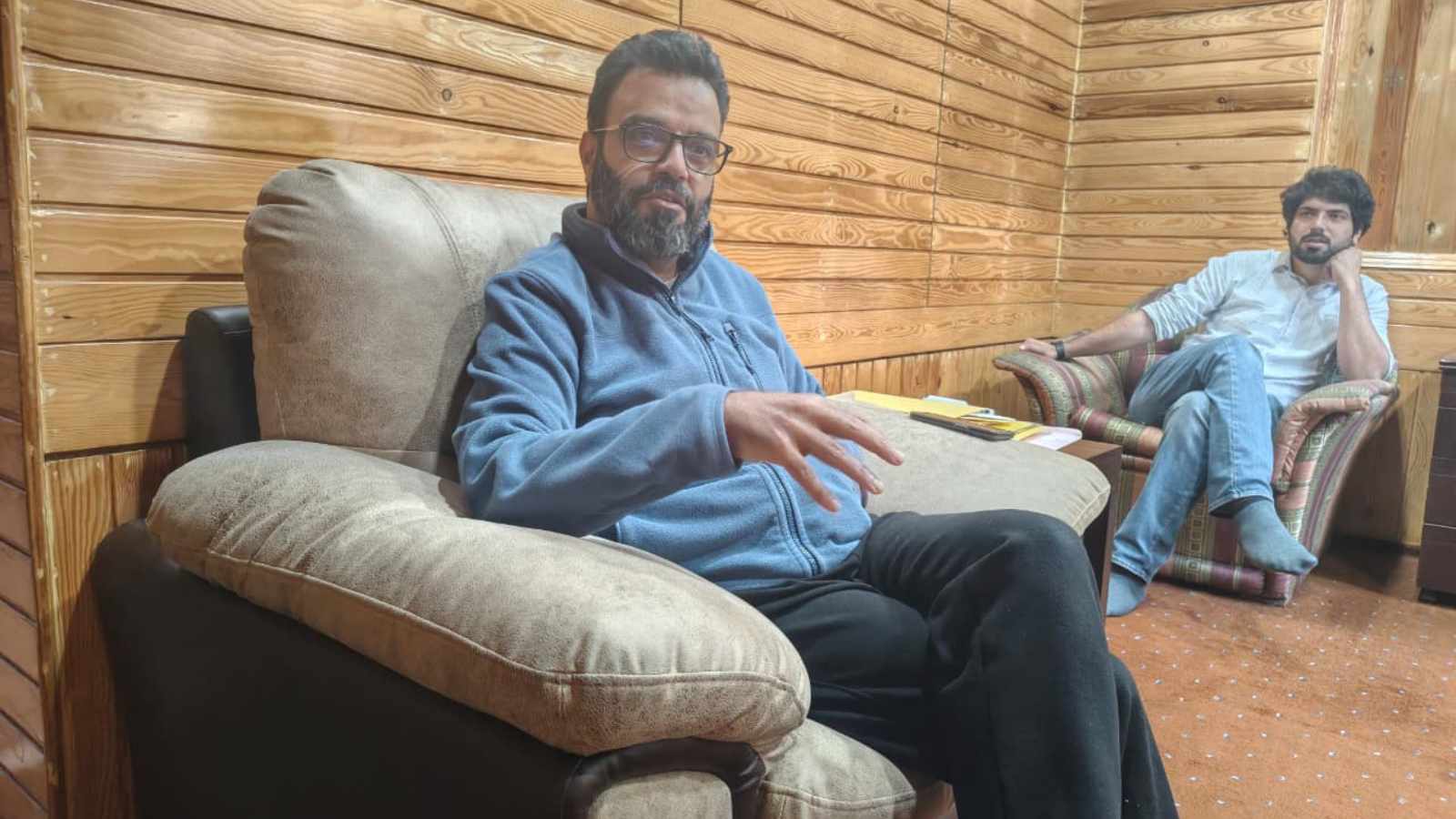
Srinagar MP Aga Syed Ruhullah Mehdi resigned from the National Conference (NC) and his parliamentary constituency Tuesday amid continued differences with Jammu and Kashmir Chief Minister Omar Abdullah and the party leadership. In an interview with The Indian Express, Mehdi explains why he believes the CM “betrayed” the resounding mandate he won in the 2024 Assembly elections, why he believes the NC is in decline, and why he is seeking a political alternative in Kashmir. Excerpts:
Aga Syed Ruhullah Mehdi: In his election campaign, the CM (Omar) said restoring statehood was not his issue; his cause was restoring Article 370. But soon after getting elected, he diluted his stand and said that the restoration of Article 370 is not his fight; he is going to fight for statehood. He spoke the language that the BJP wanted people to speak. Personally, it is a betrayal and I would not want to be a part of any deceit, lie, or betrayal. Especially when we have an existential threat in terms of political identity, political autonomy, and religious and cultural identity; our demography is under threat. We do not have scope for lies or deception.
Aga Syed Ruhullah Mehdi: I wanted clarity and that clarity was given to me by the party’s president (Farooq Abdullah) himself when he said if Aga Ruhullah thinks that 370 can be restored, he can go and get it restored, effectively meaning that he himself does not believe that 370 can be restored. That was enough clarity for me that this organisation is no longer committed to its ideology. It repeated the same mistake that people claim it has made in the past. It has surrendered to the powers in Delhi (in past) and this time around it has surrendered to the BJP.
Aga Syed Ruhullah Mehdi: The CM didn’t articulate the same things during elections. He articulated something opposite. He said that it was our job to challenge the BJP. Either he was lying then, or he is lying now. In either case, he has done politics of lies and betrayal, which for me is very difficult to continue with. I believe in principles and conviction.
Aga Syed Ruhullah Mehdi: Technically, I have the symbol with me. And the party has a claim over my seat through that symbol.
Aga Syed Ruhullah Mehdi: It was already in decline. Back in 2014, it hardly got 15 Assembly seats. After the abrogation, people wanted to vote against the BJP and register their dissent, rebel constitutionally and democratically against its decisions. They had no option because the other option, the PDP, had committed the same betrayal … So people saw the National Conference as a lesser evil or that my personal efforts in Parliament helped shape the party as a lesser evil or something that can again be given a chance. I think that is why the NC got this opportunity to rise again to do the course correction. But they lost this opportunity. The writing was already on the wall in 2014. Now it is going to be worse than that because they have betrayed. This time around, I don’t think people will forgive them. The PDP is a fresh example. They did the same kind of betrayal in 2014. The elections happened 10 years after that betrayal, but it was fresh in people’s memory.
Aga Syed Ruhullah Mehdi: There is absolutely not only a scope but a need for correction, not by these parties but by society itself. The similarity between these two political organisations is the lack of character and the only difference is their name. To understand the problem, one needs to see where the problem is. The problem is in their character. They lack conviction and principle. So, there is a need to identify people who believe in principles, who have some conviction, who have moral and political character, to take affairs into their hands. Whatever shape and form it takes, that is a secondary question. A change is needed, a change of character, a change in how politics is approached.
Aga Syed Ruhullah Mehdi: That was my argument in the last Assembly elections, when I campaigned for the party. I said we can’t afford to get further divided because that would benefit the BJP. Yes, we wanted consolidation and we got consolidation, but what did that consolidation deliver? That consolidation delivered the same thing that the BJP wanted. Therefore, the consolidation in the name of consolidation is not enough. Consolidation for a purpose is required. To consolidate for a purpose, you may need to defeat some local forces. That may look like division, but that is not a division. That is course correction.
Aga Syed Ruhullah Mehdi: I am already in touch with people. I am doing some headhunting. I am trying to find people with less or no baggage. People who have some kind of intention or will to walk this path. They may be from different fields. It is a hard task, but I want to do this hard job. I want to take this responsibility because, in my opinion, this is the only remedy to this situation. Until I find a good force of people with these characteristics, I will not announce anything in any shape or form. I would want to find hands, hands which could be trusted. Once I find those hands, we may think about shape, form, or name.
Aga Syed Ruhullah Mehdi: If there is a need for me to contest the by-election, I may contest as an Independent.
Aga Syed Ruhullah Mehdi: He scaled down the rhetoric and didn’t make the mandate of the people and the aspiration of the people a part of the discourse in national politics. He said the BJP would not listen. Ladakh showed us that the same BJP was brought back to the table by Ladakhis. They challenged the same BJP … He could have reached out to the rest of India. He could have reached out to the Opposition parties. He could have galvanised opinion from south to north.
Aga Syed Ruhullah Mehdi: He delegitimised any aspiration for Article 370, any struggle for 370. This is the CM who brought two resolutions in two years, diluting his first resolution with the second resolution. He did everything to dilute. It reminds me of another resolution which he didn’t let the J&K Assembly pass. The resolution against the Waqf Amendment Act. This is the only Muslim-majority Assembly and the irony is that it could not pass the resolution. Punjab did, Tamil Nadu did.
Aga Syed Ruhullah Mehdi: Nothing went wrong. He wanted selfies in auto-rickshaws, and he got those selfies. He wanted to send the BJP a message that I am not a threat to you and this is just for theatrics. He was able to send that message. Nothing went wrong for Omar, but everything went wrong for the people of Jammu and Kashmir. We were betrayed once again that day. A political party calling itself the largest cadre-based party couldn’t assemble 100 people for this great cause in Delhi. The organisation that assembles thousands for its election rallies and those who assemble thousands crying for their ministerial berths couldn’t gather a hundred people in Delhi for the cause of the people of J&K.
Aga Syed Ruhullah Mehdi: And what did he want to achieve through reconciliation? Was it a reconciliation or submission? It was submission. If he wanted to achieve statehood through reconciliation, why didn’t he speak about the same reconciliation in the election campaign? If those parties, those who were allied with the BJP, spoke about the same reconciliation in the election campaign, why did this CM tag them as BJP proxies? Why was reconciliation a bad word then? Why was reconciliation being BJP’s proxy then and reconciliation became a holy thing after he became CM? That is justifying his surrender.
Aga Syed Ruhullah Mehdi: Unfortunately, the people who challenged them (NC leadership) and the examples that they gave never challenged them ideologically. It was always a power tussle … They didn’t get an ideological challenge to date from within the party. And whenever they got an ideological challenge, they couldn’t stand it. The PDP somehow managed to give them an ideological challenge for a brief period of time and the National Conference couldn’t stand it.
There was an ideological challenge, a turf war happening for good 30-40 years in J&K between the NC and the Hurriyat Conference. I am not endorsing the Hurriyat Conference. Unfortunately, they were on the other side of the extreme. But when it came to ideological challenges, the streets were controlled by the other side, not by the NC. Whenever they faced an ideological challenge, they couldn’t stand it. My fight is sort of an ideological fight that the National Conference will find very difficult to handle.
Bashaarat Masood is a Special Correspondent with The Indian Express. He has been covering Jammu and ... Read More