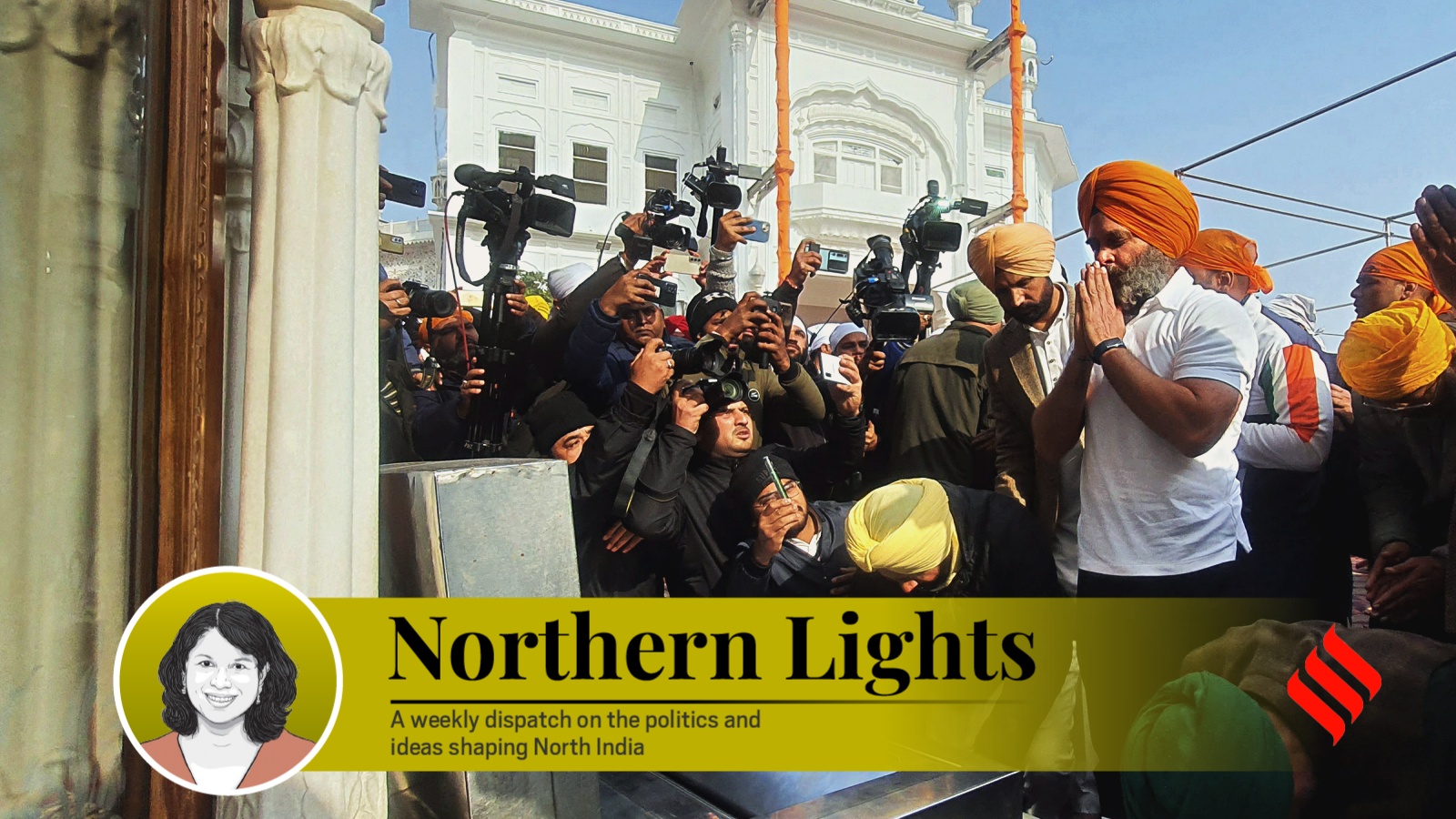
A bearded Rahul Gandhi at the Golden Temple, saffron turban in place, during his Bharat Jodo Yatra in January 2023. The Congress likes to flag this image every now and then. It suggests all is well. Operation Blue Star, so closely identified with the Gandhis, is not a burden borne by him.
They are not far from the truth. Gandhi distanced himself from the legacy when he visited the shrine in his private capacity. He did sewa and soaked in the Gurbani wafting from the precincts. But these days, it is the anti-Sikh pogrom that the BJP is trying hard to pin on him.
Once again, the state is seeing the resurgence of his father Rajiv Gandhi’s infamous statement: “When a big tree falls, the earth shakes.” Thousands of Sikhs were killed in the days after Prime Minister Indira Gandhi’s assassination on October 31, 1984.
The Congress neatly sidestepped this googly. It focused on its Insaaf rally, where speakers ridiculed the AAP government for waging a war on drugs with a “drunken” CM at the helm. They also claimed Union Home Minister Amit Shah would not be around to fulfil his 2029 promise. Yet the resurrection of those days brings to the fore the fraught relations the Gandhis have had with this border state.
The Shiromani Akali Dal, the oldest regional party in the country, had a largely mistrustful relationship with Indira Gandhi. It stemmed from the Akali demand for more federal powers, which she viewed through a communal lens.
No surprise, then, that the party opposed the Emergency tooth and nail. It sent over 40,000 workers to jail in the 19-month “Save Democracy” morcha, from July 1975 until the Emergency was revoked in early 1977. Many saw in that the seeds of Indira’s determination to show the Akalis their place.
Her son inherited both the mistrust and the possibility of repair. The July 1985 peace accord between Prime Minister Rajiv and Akali leader Sant Harchand Singh Longowal failed to deliver many of its promises, but it showed the two sides could imagine a political settlement.
A lot of water has flowed under the bridge since. Many issues that were supposedly resolved still pop up whenever Punjab goes to the polls.
It would be easy for the rest of the Opposition to pin all the blame for 1984, and the unresolved issues, on the Punjab Congress. Yet, the party has not only shrugged off the blame. It has won not once or twice but thrice since the early 1990s, when the democratic process resumed after several stints of President’s Rule.
Its 1992 victory, held in the shadow of militancy and an Akali boycott, cannot be read as democratic endorsement. But the Congress did not win in 2002 and 2017 because Punjabis forgot 1984. It returned because Punjab needed a party that could restore normalcy, access the Centre, and manage a fractured state.
Traditionally, the Akalis were considered well entrenched in the villages. The Congress retained its cadre in villages and towns alike. The Punjab unit was never merely an extension of the Gandhi family. It produced its own leaders, with their own caste, rural, and urban networks. The state unit is jokingly called “a party of leaders”.
No wonder Gandhi got a resounding roar at the Insaaf rally in Sangrur when he pointed out that unlike the AAP and the BJP governments run from the Centre, Congress governments are not.
The party often won by dint of its candidates, not one larger-than-life leader at the Centre. That was especially so after Indira, who was notorious for keeping leaders in check by appointing a state party president often at loggerheads with the CM.
Organisation alone does not explain why Punjab votes the way it does. The rest lies in how Punjab remembers.
Punjabis love to flaunt one belief: they never forget or forgive. Long ago, a brother of Beant Singh, one of Indira Gandhi’s assassins, told The Indian Express matter-of-factly that he had not been confided in about the plan. But the assassination, he said, was a foregone conclusion. Many others echoed him. It speaks of a moral universe in which certain acts cannot be forgiven.
Udham Singh’s killing of Michael O’Dwyer in London in 1940 is seen through the same lens. The community never forgets or forgives.
Yet Punjab’s politics cannot be reduced to that moral universe alone. How else does one explain the love that overflowed when then CM Captain Amarinder Singh opened the border for Pakistanis to watch the Indo-Pak Punjab Games in 2004? Punjabis in Chandigarh lined up to host the visitors in their homes.
Most came from families that had fled Pakistani Punjab with little more than the clothes on their backs. The blood-soaked Partition, you would expect, would have made them abhor people across the border. Instead, nostalgia triumphed over hatred. Filmmaker Imtiaz Ali spoke to numerous survivors for his movie Main Vaapas Aaunga. He found most chose to remember the love rather than the hate.
Punjab remembers. But its political memory is neither linear nor a ledger that closes once and for all. It reopens whenever power, identity, and grievance come into play.
One of the strongest arguments for a possible BJP rule in Punjab goes like this: if Sikhs could re-elect the Congress after 1984, how could memories of a farm agitation stop the BJP? The argument assumes that memory fades on schedule and works the same way for everyone.