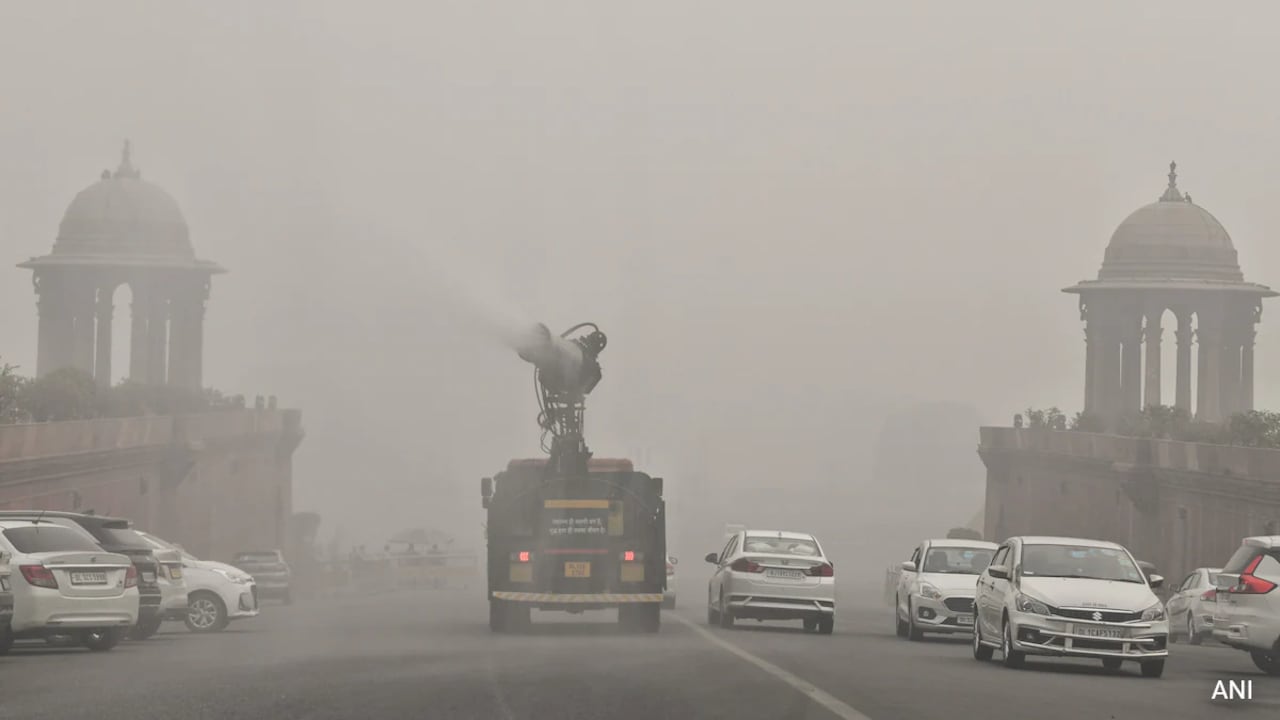
The National Capital Region (NCR) has once again plunged into a severe winter pollution crisis. As the capital braces to celebrate Diwali on November 8, 2026, thick layers of toxic smog cloud its skies. In response to rising pollution levels, the Centre's air quality watchdog, the Commission for Air Quality Management (CAQM) invoked Stage II of the Graded Response Action Plan (GRAP-2) across Delhi-NCR on Monday.
As of 9:05 AM on Wednesday, November 4, the Central Pollution Control Board's (CPCB) SAMEER app recorded Delhi's overall Air Quality Index (AQI) at 379 ("Very Poor"). Several key hotspots-including ITO, Bawana, Alipur, Delhi Technological University (DTU), IIT Delhi, and Jahangirpuri-surpassed the hazardous 400 mark, entering the "Severe" category.

To address the escalating public health risk, CAQM's GRAP Stage II mandate enforces strict measures across the region. These include intensive dust suppression, targeted vehicular restrictions, and bans on diesel generator sets in an effort to curb the rapid accumulation of particulate matter.
While seasonal drivers such as agricultural stubble burning and festive emissions routinely trigger Delhi's post-monsoon pollution spikes, experts warn that this winter poses an exceptional challenge due to global climate dynamics.
According to an advisory from the World Meteorological Organisation (WMO), the ongoing El Nino phenomenon in the tropical Pacific Ocean has intensified significantly, with sea surface temperatures running more than 3.2 degrees Celsius above average. The WMO highlights an exceptionally high probability that this powerful El Nino will persist into early 2027-amplifying extreme weather risks, shifting global wind patterns, and altering thermal profiles worldwide.

Addressing the connection between climate patterns and air quality, experts clarify that while El Nino itself does not produce emissions, it significantly alters how existing pollutants accumulate and disperse over northern India.
To understand this phenomenon better, NDTV spoke with Prof. Gufran Beig, Chair Professor at the National Institute of Advanced Studies (NIAS, IISc) and Founder Director of SAFAR, who explained how climate drivers are reshaping regional winter dynamics.
"Phenomena like El Nino and La Nina are no longer routine or predictable cycles-every single event brings distinct characteristics. These paradigm shifts are largely driven by accelerated climate change over recent decades. For example, the El Nino we are currently experiencing is one of the strongest on record, with Pacific Ocean temperatures already running more than 3.2 degrees Celsius above normal," Professor Beig explained.
Elaborating on how this affects air pollution, Professor Beig noted that Pacific warming triggers three primary atmospheric mechanisms over northern India:
1. Reduced Wind Speeds: Surface winds across northern India slow down, curtailing natural pollutant dispersion.2. Suppressed Western Disturbances: Winter rainfall that typically washes out atmospheric pollutants is significantly reduced.3. Warmer Winter Baseline: A warmer thermal baseline creates a complex tug-of-war between ambient temperature and wind speed.
Professor Beig cautions, "As we move into December and January, if temperatures drop while wind speeds remain low, reduced dispersion will almost certainly cause air pollution levels to spike sharply. In contrast, October remained warm because winter had not yet set in. Even though wind speeds were slow, warmer temperatures prevented strong thermal inversion, which is why air quality in October was noticeably better than in previous years."
NDTV also spoke with Dr. Manoj Kumar, Analyst at the Centre for Research on Energy and Clean Air (CREA), who echoed concerns about the prolonged risks posed by altered weather pattern. Dr Kumar explains, "El Nino could increase the risk of extended pollution episodes in Delhi this winter by altering local weather conditions over northern India. It weakens surface winds, meaning emissions from industries, power plants, vehicles, and other combustion sources cannot disperse effectively and remain trapped over the city for longer periods."
Dr. Kumar added that if a shallow planetary boundary layer-the lower atmospheric layer where pollutants mix-accompanies these stagnant winds, pollution will become far more concentrated near ground level. Additionally, fewer Western Disturbances mean less winter rainfall, removing a crucial natural cleansing mechanism for airborne particulate matter.
"These combined conditions could increase both the frequency and duration of 'Very Poor' and 'Severe' air quality days," Dr. Kumar concluded. "However, this remains a potential risk rather than a certainty. El Nino does not generate pollution; it merely governs how existing emissions accumulate and disperse. Ultimately, actual air quality will depend on both local emission levels and prevailing weather conditions" he added.
As Delhi heads into the festive weekend, authorities are scaling up pollution control measures with experts even questioning the effectiveness of the measures and the road ahead.
Track Latest News Live on NDTV.com and get news updates from India and around the world