A wave of protests and rallies is continuing to heat up national politics. Over the week, the INDIA bloc held a big rally in Delhi’s Ramlila Maidan against alleged “vote theft” and the controversial Special Intensive Revision (SIR) exercise. Subsequently, the BJP mounted a counter-offensive against the Opposition, hitting the streets in various cities against their “anarchy”. The Urdu dailies pulled out all the stops to cover the entire spectrum of these protests. They also highlighted the 18-day agitation of the Jamia Millia Islamia students for seeking restoration of a student union on campus, which culminated in their victory.
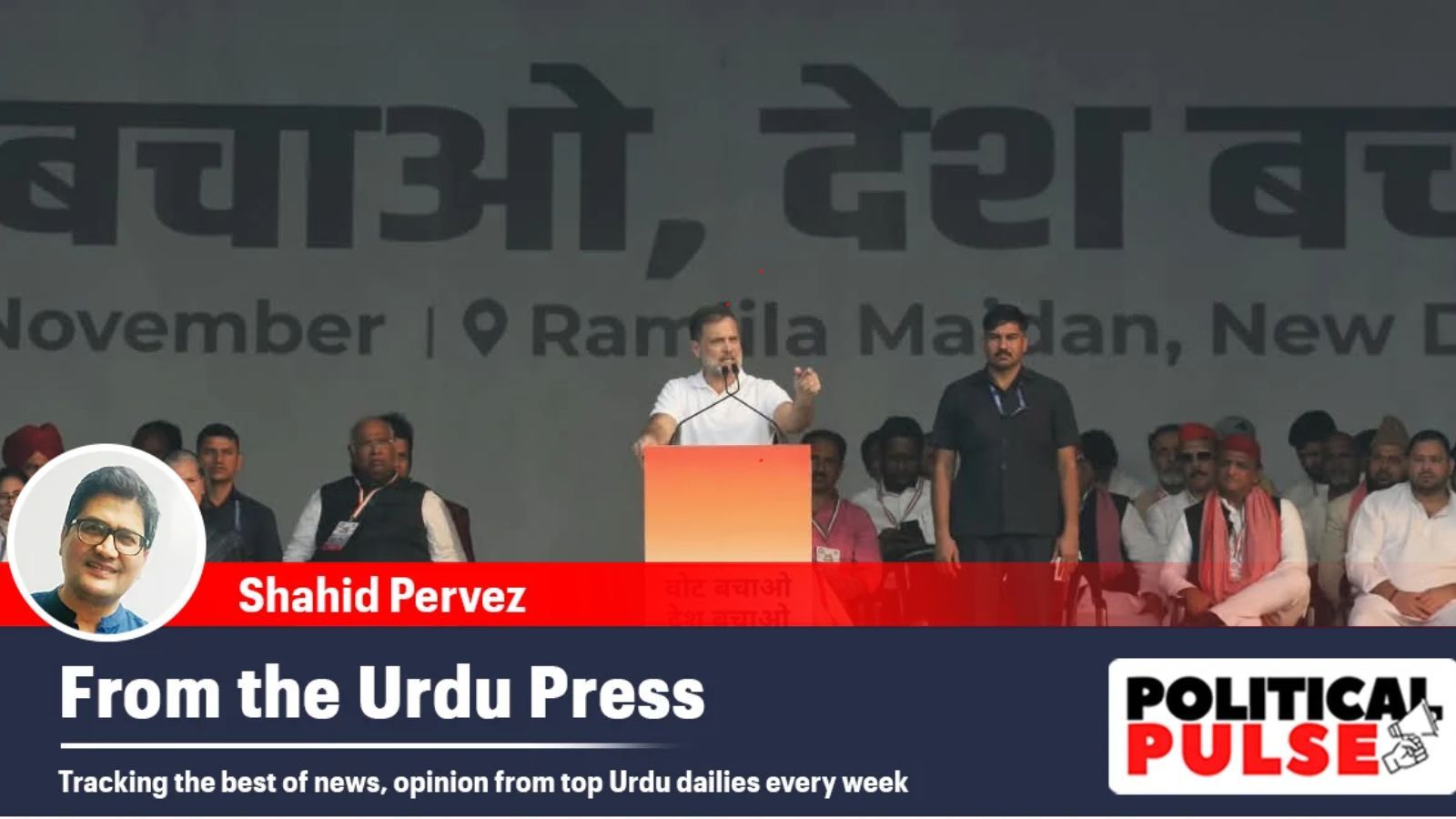
Referring to the INDIA bloc’s rally in Ramlila Maidan against Chief Election Commissioner (CEC) Gyanesh Kumar and the Modi government over alleged electoral irregularities and the SIR, the Hyderabad-based Siasat, in its November 2 editorial, says that tens of thousands of people attended it to send out a message that the right to vote is sacrosanct. At the rally, the Opposition leaders alleged that “vote chori was committed as part of a conspiracy to grab power”, it notes. “The BJP dispensation seems to have been rattled by wide resonance that the rally created among people. It apprehends that this campaign could spiral and intensify across the country in the coming days. Vote deletion is not a minor issue — it has cast a shadow over our country’s exemplary democracy.”
The daily points out that besides the leaders and workers of the Opposition alliance, the Ramlila Maidan meeting was attended by large sections of youths, students, farmers and the civil society. “The row over en masse deletion of voters’ names from the rolls under the SIR has been snowballing as it has a bearing on people’s fundamental right besides the future of India and its democracy. The Ramlila ground rally could mark the beginning of a countrywide stir which could transcend political parties and groups,” it says.
With the students of Delhi’s Jamia Millia Islamia calling off their 18-day protest after its administration agreed to a fixed timeline for holding student union elections, the Hyderabad-based daily Etemaad, in its October 31 leader, points out that the university has issued an order setting May 15, 2027 as the deadline for approving the student union constitution with the elections to be held within six weeks of the start of the new academic session from July 2027. The Jamia students had been protesting for restoration of their student union which had been dissolved in 2006, the editorial notes. “The breakthrough came when the students were commemorating Jamia’s 106th Foundation Day at the varsity’s Gulistan-e-Ghalib compound. It marks a major win for the student protesters.” The edit states that the Jamia authorities had cracked down on agitating students, including those who had been on a hunger strike. “They have now announced revocation of all disciplinary actions, including suspensions and rustications,” it says. “The university has also decided to resume offline classes and academic activities, days after shifting them online. A key sticking point between the two sides was the students’ demand that the administration set a fixed timeline for holding student union polls,” the edit says, adding that Delhi Police had detained scores of students since the stir began.
“The Jamia students are celebrating their victory which would go down in the university’s glorious history,” the daily writes. It notes that Jamia was originally established in Aligarh as part of the movement against the British Raj during the freedom struggle after Mahatma Gandhi gave a call to boycott the colonial institutions. “Many teachers and students sacrificed their bright careers for the establishment of Jamia, with its founders including Maulana Muhammad Ali Jauhar, Hakim Ajmal Khan, Mukhtar Ahmad Ansari, Abdul Majeed Khwaja and Zakir Husain playing key roles in turning its dream into reality,” the edit says. “The objective of this leading institution has always been to prepare students who would have higher learning with self-independence, freedom with responsibility, and knowledge with a national consciousness. Jamia has had a turbulent history, with questions periodically raised over its existence and future. Even today, the university needs the same vision which helped it overcome multiple challenges in the past.”
Commenting on the Legislative Council elections in 28 seats across four major states, the New Delhi edition of Inquilab, in its October 31 editorial, states that its outcome has put a question mark over the BJP’s supposed electoral invincibility. It points out that the BJP was defeated by the Opposition parties in several constituencies, including both the Graduates and Teachers seats in Uttar Pradesh’s Varanasi, which is Prime Minister Narendra Modi’s Lok Sabha seat, and in Maharashtra’s Nagpur, where the RSS headquarter is located. While the Samajwadi Party (SP) won the two Varanasi seats, the Congress managed to retain its Nagpur Graduates constituency. “These results send a message that power and popularity are not always synonymous. For the BJP, the MLC poll outcome may not be just a jolt but a sign of shifting sands, which the party can ignore only at its own peril,” the edit says.
The daily writes that the BJP had made religious polarisation and aggressive nationalism its central plank in election after election. “This trend could however not be sustained perennially. When youth face an uncertain future due to the faltering education and examination systems and a deepening job crisis, the emotive sloganeering automatically starts losing its appeal. The current cycle of youth unrest, Opposition protests and the MLC results should be seen in this context,” it says.
While the MLC polls could not be a barometer of general elections, it gives a sense of public mood, especially in the BJP strongholds, says the editorial. “This busts the perception that polarisation could keep public attention diverted from real issues indefinitely. The Gen Z angst in the country could not be limited to merely the demand for resignation of a minister. For it could also be a blowback against a political culture that always calls out critics and brands dissenters anti-national,” it states. “In a democracy, youths are not meant for only attending election rallies, but also to question power and seek accountability.”
The edit underlines that political change comes in India only through peaceful protests and democratic elections. “A key lesson from history is that while a government often dismisses such public discontent and stirs as inconsequential, they often lead to enormous changes,” it says, adding that the BJP will face an acid test in the upcoming UP Assembly elections. “It is also imperative for the Opposition that rather than just highlighting the government’s failings, they should also present their alternative roadmap for education and jobs, and youth empowerment and social justice.”
Shahid Pervez is Associate Editor of The Indian Express. He works closely with repo... Read More