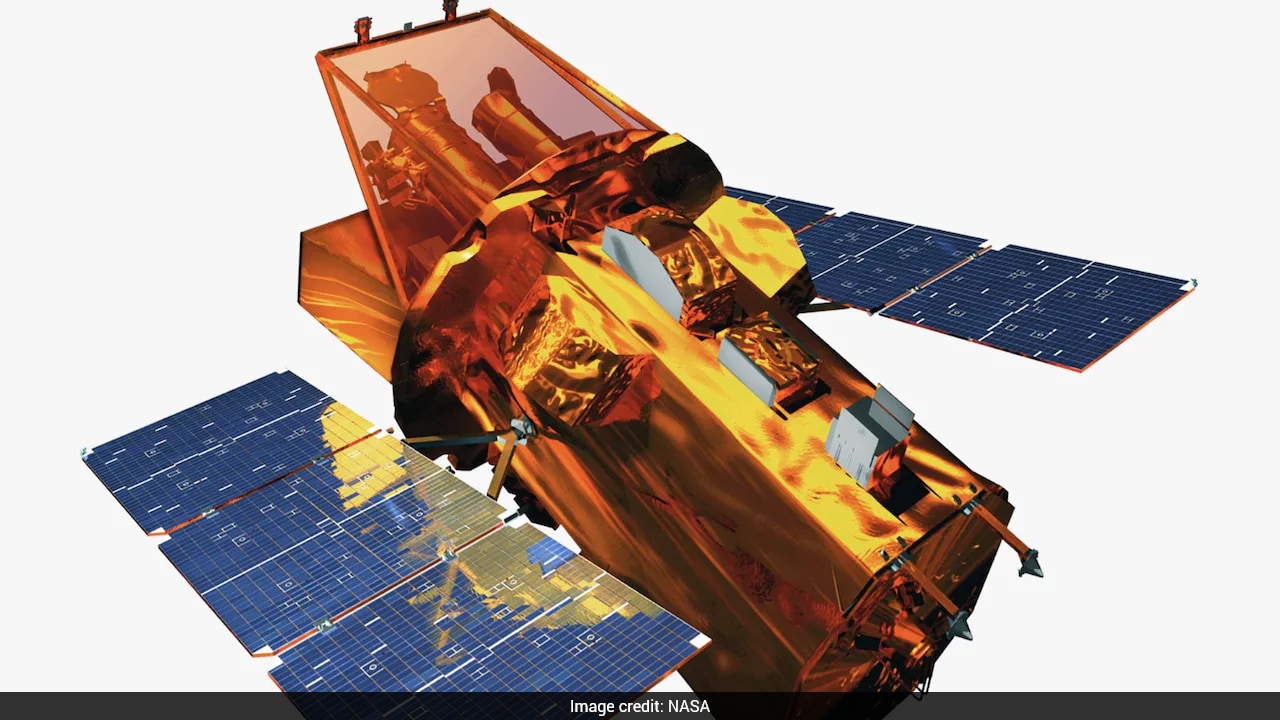
NASA's Neil Gehrels Swift Observatory, a 1.5 tonne space telescope, is heading back to Earth - to crash. The telescope was launched on November 20, 2004, almost 22 years ago. It was initially known as the Swift Gamma-Ray Burst Explorer. According to the US space agency, the telescope will hit the atmosphere on November 4 at around 3.30 am ET (2 pm IST) but there's an 11-hour window for re-entry. Most of the telescope is expected to burn up in the orbit, but a few components could reach Earth.
NASA's Brad Cenko, the mission's chief scientist, told the Associated Press that parts of Africa, Australia, India, Southeast Asia and Central and South America are within the telescope's re-entry zone.

NASA estimates that the telescope's re-entry zone lies between 20.6 degrees south latitude and 20.6 degrees north latitude. On a map, that creates a band covering portions in the middle of the Earth.
In context of India, this broad band covers regions south of an imaginary line running approximately from Daman on the western coast to Cuttack in Odisha on the eastern coast. Mumbai, Hyderabad, Bengaluru and Chennai fall within the zone, while Delhi, Kolkata and much of northern India lie outside it.
However, being within the latitude band does not mean that these cities are directly in the path of falling debris. The actual re-entry location depends on the telescope's position when it enters the atmosphere.

India has its own infrastructure to monitor objects approaching atmospheric re-entry. ISRO's Multi-Object Tracking Radar (MOTR), located at Sriharikota, tracks space objects, including rocket bodies and satellites, during their final few orbits before atmospheric re-entry.
However, there is no word from ISRO if it is tracking the descending space telescope. Some experts believe that the Neil Gehrels will land in the ocean.
"Obviously a lot of that latitude band is ocean," Jonathan McDowell, an astrophysicist and honorary professor at Durham University, told Gizmodo.
McDowell says he will be surprised if 100 kilogram of the component from the telescope's 1,500 kg weight survives re-entry.
"If 70 per cent of the Earth is ocean, 30 per cent is land. So three out of 10 times it's on land, not ocean," Brad Tucker, an astrophysicist at the Australian National University, told ABC News.
They also said that chances of a falling piece of the telescope damaging infrastructure or injuring someone are extremely low.
NASA's efforts to save the falling telescope were unsuccessful.
The mission was supposed to last for two years, but its career surprisingly lasted much longer. In its 22-year journey, Swift observed more than 2,000 gamma-ray bursts and 1,400 supernovae.
Track Latest News Live on NDTV.com and get news updates from India and around the world