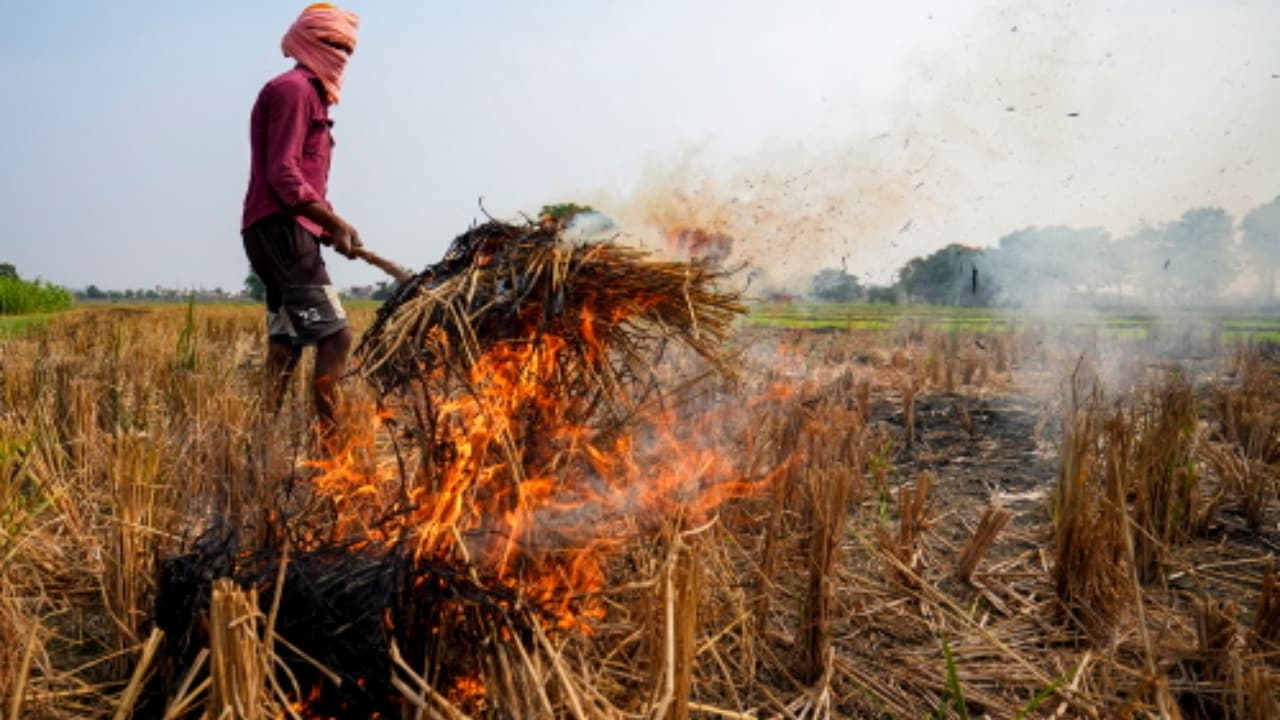
Punjab's battle against stubble burning has hit a peculiar geographical roadblock in its border district of Fazilka, where even farm machinery meant to manage paddy straw is proving ineffective. With groundwater rising close to the surface and upward seepage keeping agricultural fields waterlogged, farmers say tractors, balers and other specialised equipment cannot operate in their fields, leaving them with few practical options to dispose of paddy residue without burning it.
The problem came into focus during a visit by a team from the Commission for Air Quality Management (CAQM) to Fazilka, as the commission stepped up inspections in Punjab amid worsening air quality in Delhi-NCR. The team visited villages to assess stubble management arrangements, inspect the use of agricultural machinery and understand why farmers in certain areas continue to face difficulties in managing paddy straw.

For farmers in waterlogged villages, however, the challenge is not necessarily the availability of machinery but the inability to operate it. Thakar Singh Bhullar, a farmer from Dhipanwali village, told the visiting team that the underground water level in the area was so high that agricultural equipment frequently got stuck in the fields. Even making bales of paddy straw and transporting them out of the fields becomes difficult under such conditions.
Upward seepage, in which groundwater located close to the surface rises into the soil, has resulted in persistent waterlogging in several pockets of Punjab. With the soil remaining saturated, tractors and heavy agricultural equipment struggle to move across fields. The problem also affects sowing and other post-harvest agricultural operations. In some affected areas, groundwater has been reported to be only a few feet below the surface.
The farmers told the CAQM team that the conventional solutions being promoted for stubble management were not suited to their geographical conditions. They appealed to the Centre and the Punjab government to devise a separate strategy for such villages. They even sought permission to burn stubble under these exceptional circumstances or provide an alternative mechanism for its disposal.

Senior CAQM official Dr TS Pawar said stubble burning was among the factors contributing to pollution in Delhi-NCR and that the commission was visiting Punjab's identified hotspots to assess the situation. The team was interacting with farmers, examining in-situ and ex-situ stubble management measures and reviewing the efforts being made by the Punjab government and district administration.
The inspection also involved officials from the Punjab Pollution Control Board, Agriculture Department, district administration and police. The CAQM team asked officials to work with farmers to address the practical difficulties preventing effective stubble management.
Track Latest News Live on NDTV.com and get news updates from India and around the world