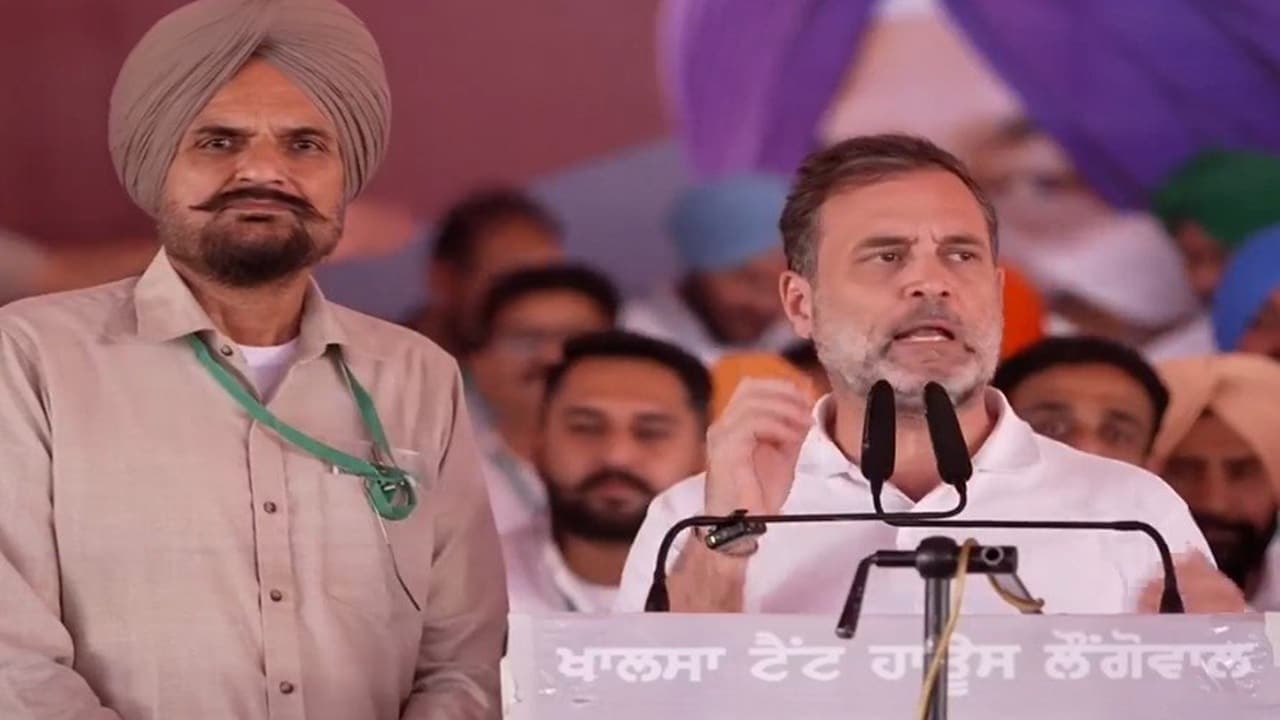
Rahul Gandhi was addressing the Congress rally in Sangrur when he paused to call out to a man seated towards the rear of the stage. It was Balkaur Singh Sidhu, the father of Sidhu Moosewala. Gandhi invited him forward. A chair was brought, and Balkaur Singh was seated beside him. For several minutes, the campaign address turned into a recollection of a young singer, a father's grief and a life cut short.
The gesture gave Balkaur Singh a place at the centre of the proceedings. It also brought the question he has carried for more than four years - justice for his son - back into Punjab's election campaign.
Gandhi said his meeting with Moosewala's father had prompted him to change the direction of his speech. He recalled the singer's visit to his office before joining Congress: A talented, energetic young man whose music Gandhi had not yet heard. He subsequently listened to his songs, including "295".
The scene illustrated Moosewala's unusual political afterlife. He lost the only assembly election he contested. Yet his name continues to command attention at rallies, and his father remains a public voice which political leaders cannot easily overlook.
Rahul Gandhi's recollection focused on the distance between Moosewala's artistic confidence and his relative unfamiliarity with politics.
Rahul remembered feeling that the singer was entering difficult political territory and wanting to provide him with political protection. That distinction is important: He was describing support for a newcomer navigating politics, rather than claiming to have arranged physical security.
Gandhi also recalled the anguish Balkaur Singh had expressed after losing his son. The speech then moved from personal remembrance to a wider argument about gangsterism, intimidation and the vulnerability of people seeking to make something of their lives in Punjab.
A debate about law and order can disappear into statistics and competing government claims. A father seated beside the speaker gives that debate a recognisable human presence.
But political pundits maintain that the emotional force of the scene also creates an obligation and once a party invokes a family's grief to make its case for power, it must explain what it would do differently.
Moosewala's continuing relevance cannot be understood solely through his brief Congress career. His music travelled beyond Punjab and beyond India. More importantly for politics, some of his songs gave listeners a language for expressing their own frustrations and attachments.
"295" deals with controversy, public judgement and the consequences of speaking out. "The Last Ride", released shortly before his murder, acquired a haunting significance after his death. In '295', Moosewala warned of people seeking fame by using another person's name. That warning offers a useful lens through which to examine the political use of his legacy.
"Kuchh ethe chaandi chamkauna chaunde ne, Kuchh tainu fad thalle launa chaunde ne, Kuchh ke ne aye ethe bhukhe fame de ,Naam laike tera agge auna chaunde ne". ("Some here want to cash in. Some want to drag you down. Some are hungry for fame - They want to get ahead by using your name.")
His posthumous "SYL" addressed Punjab's disputed river-water rights.
These songs explain part of his lasting presence in public debate. His audience encountered questions of identity, power and Punjab's future through music before hearing politicians address them from election platforms.
That connection gives parties an incentive to invoke his name. It does not give any party ownership of his listeners.
On May 29, 2022, Moosewala - whose full name was Shubhdeep Singh Sidhu - was shot dead at Jawaharke village in Mansa district. He was 28.
He was travelling in a Mahindra Thar with two companions when gunmen intercepted the vehicle and opened fire. His killing came a day after his security cover was reduced. Two security personnel remained assigned to him, but they were not accompanying him that evening.
According to the Punjab Police chargesheet, Goldy Brar -designated a terrorist by India under the UAPA in January 2024 -informed the shooters of the reduction in security and urged them to act. The timing, and the public disclosure of the security decision, became central to the family's demand for accountability.
Investigators alleged that Brar coordinated the killing with Lawrence Bishnoi and other accused to avenge the murder of Youth Akali Dal leader Vicky Middukhera.
That is the prosecution's account of the alleged motive. It must not be presented as proof that Moosewala participated in Middukhera's murder, or as a justification for killing him.