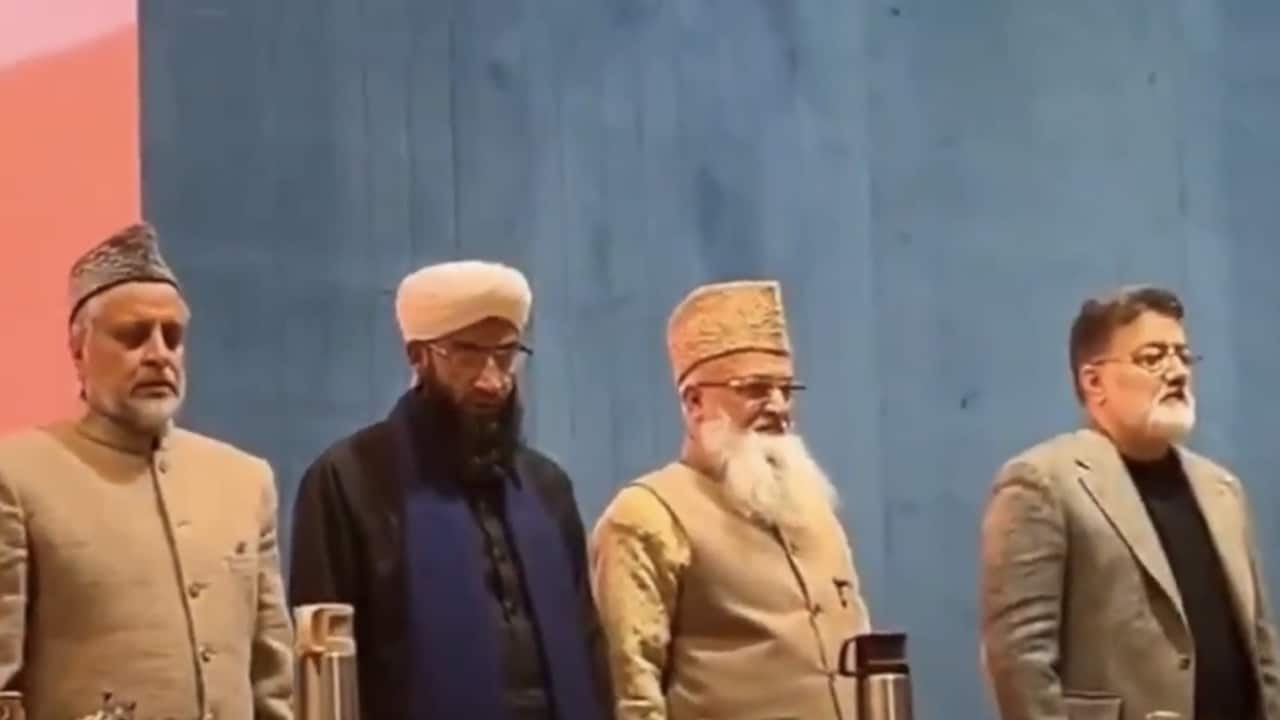
Two days after standing up for the national song, Vande Mataram, at an event of the J&K Waqf Board in Srinagar, a group of Muslim clerics in Kashmir apologised and expressed repentance over their participation, as the song is considered by some religious sections un-Islamic over its lyrics glorifying the motherland as divine by invoking multiple Hindu goddesses.
The clerics also recited the kalima, core Islamic declarations and prayers, as reaffirmation of faith and forgiveness from Allah.
Dozens of imams and other clerics attended the function on Monday, where Union Minority Affairs Minister Kiren Rijiju was the chief guest and where Vande Mataram, with all its six stanzas, was played. The event was presided over by Union Minority Affairs Minister Kiren Rijiju.
READ | 'It's Contrary To Islamic Beliefs': Vande Mataram At J&K Event Leads To A Row, Mirwaiz Explains Objection
The J&K Waqf Board is headed by BJP leader Darakhshan Andrabi, overseeing the management of most of the prominent mosques and shrines in J&K, including Dargah Hazratbal. On Monday, the board organised its first-ever Waqf Day function, and most of the imams under the board and other Muslim clerics attended the function.
As the videos of imams standing for the recitation of Vande Mataram were widely shared on social media, they came under strong criticism.
"It was a mistake. We regret it and seek forgiveness from Allah," said a group of clerics in a video message circulated on social media.
READ | No Punishment For Not Singing Vande Mataram: Supreme Court To Centre
Some prominent religious scholars have welcomed the apology and repentance of the imam and clerics, describing it as a positive step.
But the Muslim Majlis-e-Ulama, an amalgam of religious and social organisations in Kashmir, has strongly disapproved of the incident. Led by the Mirwaiz, it reiterated that there can be no compromise on the Tawheed ('oneness of God') and religious freedom. "While Islam encourages love for one's homeland, it draws a clear distinction between love for one's homeland and its worship or deification. Any expression or practice that attributes divinity to the motherland is contrary to the fundamental Islamic belief of Tawheed and is, therefore, un-Islamic and impermissible for Muslims," it said in a statement
"It is highly regrettable and unacceptable that Vande Mataram was played at a function organised by the Waqf Board itself, an institution entrusted with safeguarding Muslim religious endowments and their sanctity,"
The amulgam said that there was no legal obligation to play Vande Mataram simply because it was an official function, and playing it was optional . "Yet the Waqf Board went ahead with it with utter disregard for the fundamental religious beliefs and sensitivities of Kashmiri Muslims, which has caused deep hurt and anguish among people," it argued.
The board and the minister have not yet reacted to the row.
READ | In A First, Vande Mataram Played At India-Afghan Match, Congress Asks Why
Track Latest News Live on NDTV.com and get news updates from India and around the world