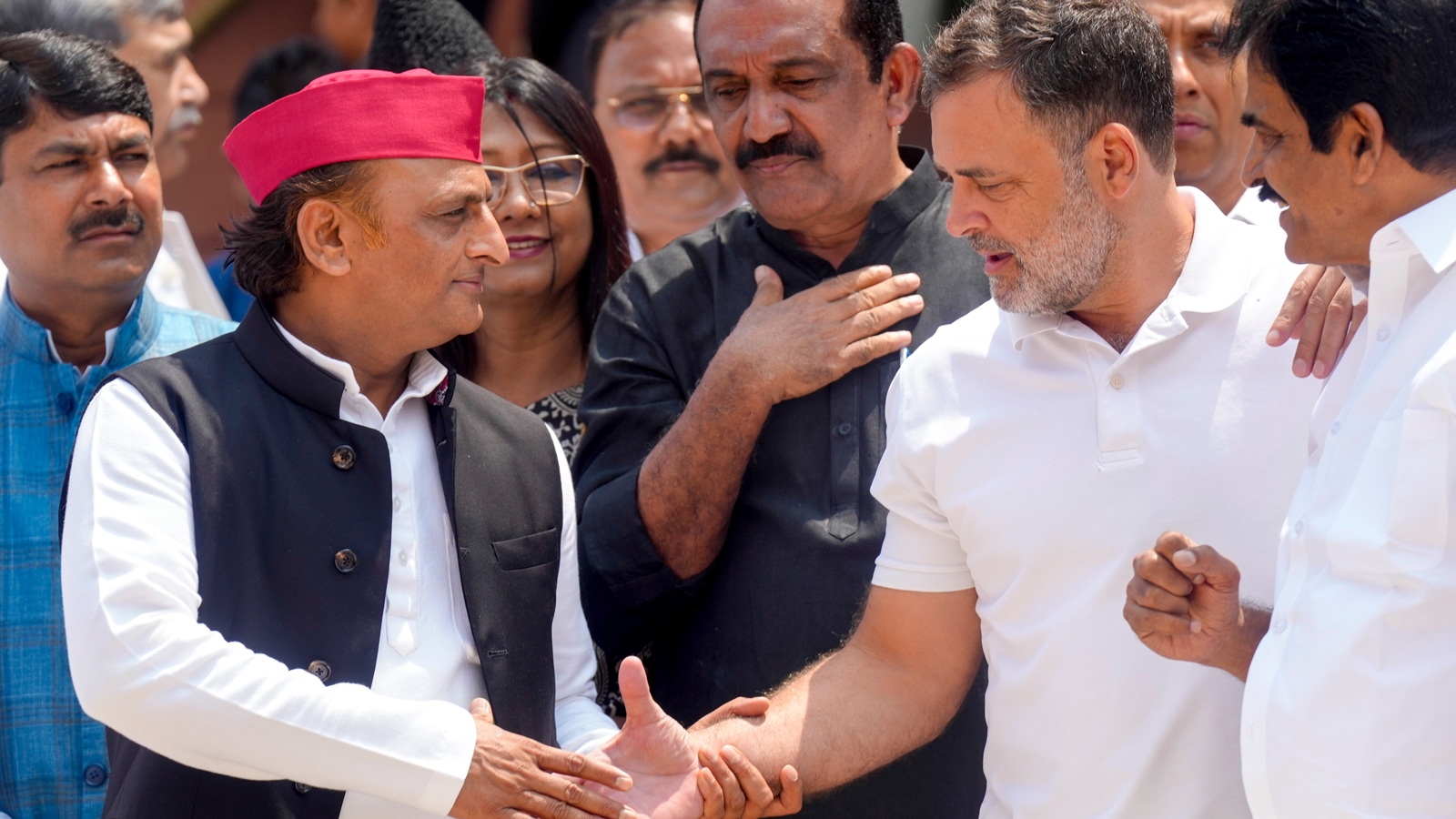
If offering just 26 seats was not enough, the Samajwadi Party (SP) has left the Congress even more livid by including just one Assembly seat from the Lok Sabha constituencies of Amethi and Rae Bareli — the pocket borough of the Gandhis — in its initial offer.
The electoral history of the 10 Assembly constituencies which make up the two parliamentary seats offers a window into why the SP may have been reluctant to offer more in the region. However, later that day, in a note posted on X, SP president Akhilesh Yadav told the Congress that his party remains open to discussing seats and that winnability should drive the negotiations.
The Congress’s claim to the Assembly seats in the region rests largely on its long political association with the Gandhi family. Rahul Gandhi’s uncle Sanjay Gandhi, father Rajiv Gandhi, mother Sonia Gandhi, and the Leader of Opposition (LoP) himself have represented Amethi, while Rae Bareli has been represented by former PM Indira Gandhi, Sonia, and now Rahul. The two constituencies have remained central to the party’s political identity in Uttar Pradesh.
However, the Assembly election history presents a very different picture. The Congress failed to win even one of the 10 Assembly constituencies in the 2022 elections, in which the party’s campaign was helmed by Rahul Gandhi’s sister and current Wayanad MP Priyanka Gandhi Vadra. The SP won six, while the other four went to the BJP.
A closer look at the election history of these 10 seats shows that 2007 was, in many ways, the last significant electoral high for Congress in the region. Several Assembly seats that the party had won over successive elections, including Bachhrawan, Sareni, and Amethi, are among those where its last victory came in 2007.
In other constituencies, such as Harchandpur and Rae Bareli, the Congress managed a victory in 2017, but failed to sustain its presence.
Since 2012, the electoral contest in most of these constituencies has increasingly shifted to the SP and BJP. The SP consolidated its position in Amethi, Gauriganj, Bachhrawan, Harchandpur, Sareni and Unchahar, while the BJP made inroads in Rae Bareli, Bachhrawan and Sareni at different points.
The 2017 Assembly elections briefly offered the Congress some hope, with the party winning Harchandpur and Rae Bareli, but these gains proved temporary. By 2022, the party had been pushed out of the electoral contest altogether.
For Akhilesh Yadav, the argument is not about the Gandhi family’s historical association with Amethi and Rae Bareli, but about the political reality on the ground, according to party insiders. The SP has emerged as the principal challenger to the BJP across much of this belt, while the Congress has struggled to establish a viable Assembly-level presence.
The five Assembly constituencies under Amethi — Amethi, Gauriganj, Jagdishpur, Salon and Tiloi — illustrate the gradual erosion of Congress’s influence.
The five Assembly constituencies under Rae Bareli — Bachhrawan, Harchandpur, Rae Bareli, Sareni and Unchahar — provide an even stronger explanation for the SP’s position.
The contrast between the two levels of elections is at the heart of the disagreement.
The Gandhi family’s association with Amethi and Rae Bareli has given Congress a political and symbolic advantage that few other constituencies in Uttar Pradesh can match. Rahul Gandhi’s victory from Rae Bareli and the party’s victory in Amethi in the 2024 Lok Sabha elections further reinforced this association, though Rahul’s loss from Amethi in 2019 had underlined that the family’s grip had slipped.
Moreover, these victories came in an alliance with the SP and do not necessarily reflect the Congress’s independent organisational strength in these constituencies.
For Akhilesh Yadav, therefore, the question is not how long the Gandhi family has represented these Lok Sabha constituencies, but how many Assembly seats Congress can realistically win on its own. With the SP having won six of the 10 seats in 2022, it claims to have a stronger electoral argument for retaining most of the constituencies.
There is also a local leadership question. Giving seats to the Congress would mean potentially overlooking SP leaders and aspirants who have built their political bases over several elections. In constituencies such as Gauriganj, where the party is dealing with the fallout of a former MLA’s expulsion and political realignment, the stakes are even higher.
The Congress, meanwhile, wants to use its 2024 Lok Sabha revival to regain political space in UP and rebuild its organisation ahead of the 2027 elections. A token allocation in a region historically associated with the Gandhi family would underline the extent of its dependence on the SP.
More than a strained relationship between allies, the offer of just one seat, Jagdishpur, reflects the changing balance of power in a region where the Congress continues to enjoy a formidable Lok Sabha legacy, but the SP has acquired a much stronger Assembly-level presence.
Maulshree Seth is an Assistant Editor with Read More